

When Kendrick Lamar hit the stage for the 2025 Super Bowl halftime show, it wasn’t just about music. It was a powerful moment of defiance, resistance, and a call for change. Kendrick took over the biggest stage in the world to remind us all that the culture isn’t just something to be watched—it’s something to be felt, understood, and fought for.
This wasn’t your average halftime performance. Kendrick Lamar flipped the script on what it means to use your platform. Every lyric, every visual, and every moment spoke directly to the Black community’s ongoing fight for justice, recognition, and respect. Let’s break it down.
Uncle Sam Ain’t Who He Claims to Be
The opening moment of the show hit hard. Samuel L. Jackson as Uncle Sam isn’t the patriotic figure we all think of. Nah, this Uncle Sam represents the system that’s been holding us back for centuries. When Jackson said, “Welcome to the Great American Game,” he wasn’t just talking about football—he was talking about the game America’s been playing with our lives, our freedom, and our futures.
We’ve always been told we’re “too loud, too ghetto, too angry.” But Kendrick came out to flip that narrative and show that we’re not the problem—America is. Uncle Sam might represent “freedom,” but for us, that freedom’s always been denied. Kendrick stepped up to say, “We’re done with that,” and it was clear the world was about to hear what he had to say.

The Revolution Will Be Televised—And It’s Loud
Kendrick threw down the gauntlet when he said, “The revolution will be televised.” Now, anyone who knows their history knows this was a twist on Gil Scott-Heron’s famous line. Back in the day, the revolution was kept hidden from mainstream media. But in 2025? The revolution isn’t just happening—it’s front and center, during the Super Bowl halftime show.
Kendrick wasn’t just performing; he was making sure that the fight for Black liberation and justice wasn’t being ignored. By choosing the biggest stage in the world, Kendrick took control of the narrative. The revolution isn’t just a movement in the streets; it’s right here, on our screens, loud and clear.
Reversing Time: A Call to Undo the Past
One of the most powerful parts of Kendrick’s performance was how he and his dancers moved in reverse. That wasn’t just choreography—it was a statement: we need to undo the wrongs of the past. We can’t keep ignoring the history of Black oppression in this country. Time doesn’t need to be linear—it needs to go backward, to the moments we were robbed of justice, opportunity, and freedom.
When the dancers formed the American flag, it wasn’t just a tribute to the nation; it was a reminder of all the promises this country made but never kept. The flag has always represented liberty—but for us, it’s been anything but. Kendrick’s performance pushed the question: If the flag really stands for freedom and justice, why hasn’t it been granted to us?

40 Acres and a Mule: The Promise Never Kept
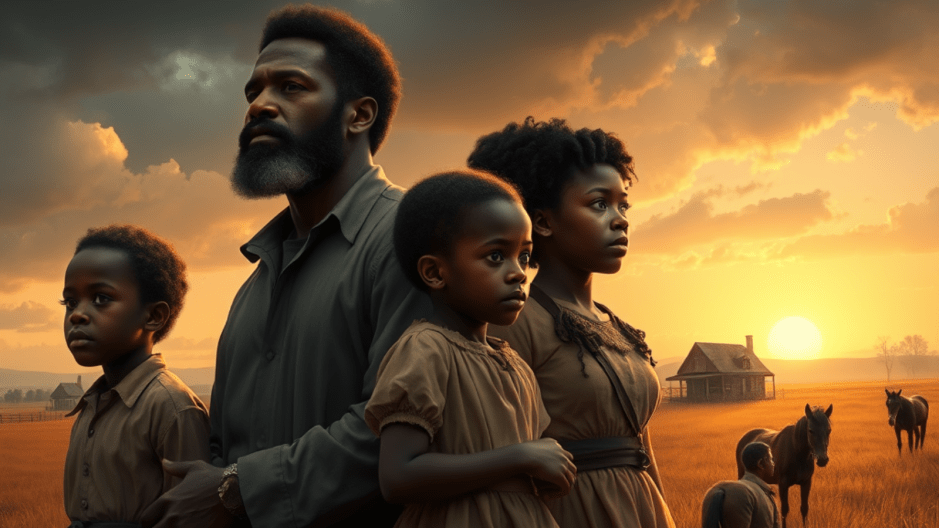
This line hit deep. When Kendrick brought up “40 acres and a mule,” he wasn’t just making a historical reference. He was talking about the government’s broken promises to Black Americans. After the Civil War, newly freed slaves were promised 40 acres of land and a mule to rebuild their lives. But we all know what happened—those promises were never fulfilled.
The idea behind 40 acres and a mule was meant to give us the tools for economic independence. But the government didn’t keep its word. Kendrick brought this up to remind us that this betrayal didn’t end in the 1800s—it continues today, through policies and practices that still limit our ability to thrive economically. It was a call to recognize that reparations are long overdue.
The “A Minor” Necklace: A Different Kind of Alpha
Now, let’s talk about that necklace Kendrick wore. The “A Minor” pendant had people talking, and for good reason. At first, many thought it was a jab at his ongoing tension with Drake, but it’s deeper than that. The lowercase “a” isn’t about playing a game of rap beef—it’s a symbol of Kendrick’s unique approach to power.
In a world where power is often loud and in your face, Kendrick’s subtle “A” says, “I’m the Alpha—but I don’t need to shout about it.” It’s a quiet confidence. He doesn’t need to dominate every conversation to prove he’s at the top. Kendrick’s power comes from his authenticity, his influence, and his refusal to be anyone other than himself. This is leadership that doesn’t need to flex—it just exists.

Kendrick Lamar: The Alpha, The GOAT, The One Who Leads
In the world of hip-hop, the term “Alpha” gets thrown around a lot. But Kendrick Lamar is the real deal. He doesn’t need to yell or boast. He shows up, and the world listens. He redefines what it means to be the greatest of all time—the GOAT. And it’s not just about bars or beats—it’s about shaping culture, speaking truth, and leading by example.
Kendrick’s impact goes far beyond music. He’s changing the way we look at power in hip-hop, in society, and in our communities. Being the “Alpha” isn’t about being loud or brash. It’s about having the vision to lead from the front, whether people realize it or not. Kendrick Lamar’s performance at the Super Bowl showed us that the real leaders in hip-hop aren’t the ones who shout the loudest—they’re the ones who speak truth, even when it’s uncomfortable.
America, It’s Time to Stand Up
Kendrick’s performance wasn’t just about calling out the music industry—it was about calling out America, too. Through songs like “Not Like Us,” Kendrick confronted the fact that the system’s been rigged for so long that it’s hard to even imagine real change. But with his performance, he showed us that we don’t have to accept the status quo.
The inclusion of Serena Williams, who performed the Crip walk alongside Kendrick, was a powerful visual of unity and resistance. It showed that no matter how much they try to suppress us, we’re gonna rise up. And we’re gonna do it together.
“GAME OVER”
Kendrick closed his performance with a simple but profound message: “GAME OVER.” He wasn’t just ending his set—he was making a statement. The old ways are done. It’s time for a new era, one where justice, equality, and respect are at the forefront. Kendrick Lamar isn’t just playing the game—he’s rewriting the rules.
Kendrick Lamar’s Legacy of Resistance
Kendrick’s Super Bowl halftime performance was more than just a show. It was a revolutionary moment for the culture, for the community, and for the world. From flipping the script on American symbols to calling out the government’s broken promises, Kendrick used this moment to say everything we’ve been waiting to hear: we’re here, we’re not backing down, and we won’t be ignored anymore.
Kendrick Lamar isn’t just a rapper—he’s a leader, a revolutionary, and a symbol of the power we hold when we come together and demand change. The revolution isn’t coming—it’s here, and Kendrick Lamar is leading the way.

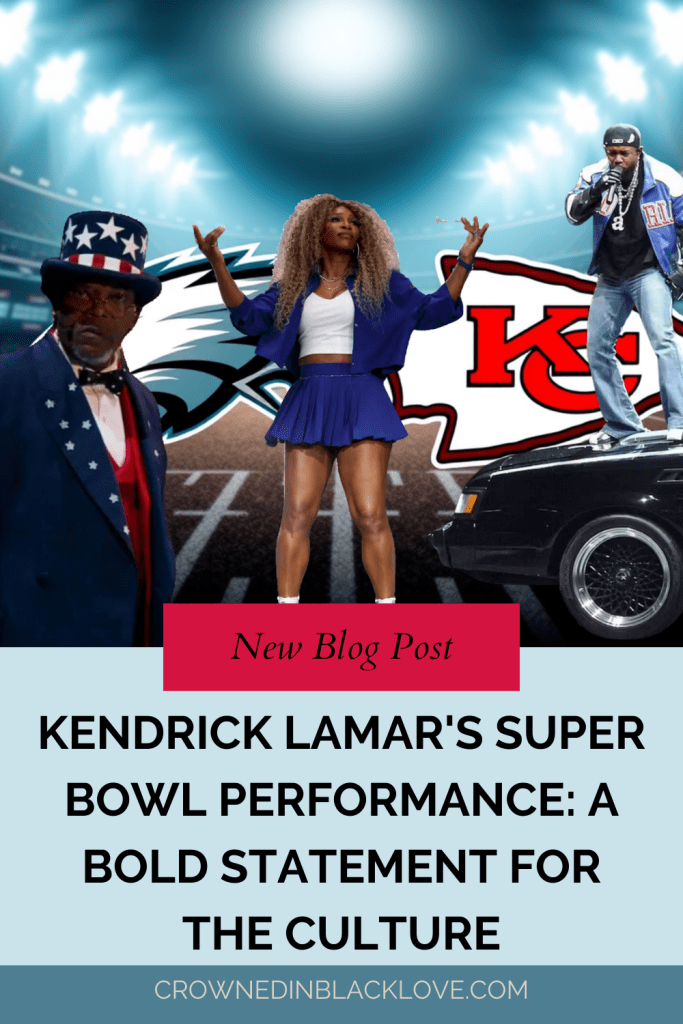
Kendrick Lamar’s Super Bowl halftime show wasn’t just a performance—it was a statement. 🎤 Watch how Kendrick used the world’s biggest stage to flip the script on power & injustice. #KendrickLamar #SuperBowl2025 #Culture #Resistance


 Crowned in Black Love